The Tinnitise Approach
Tinnitus is not an ear problem, but rather an issue with how your brain processes sound. When there is mild hearing loss, the brain compensates by "turning up the internal volume," creating that constant ringing. Our application uses principles of habituation and neuroplasticity to teach your brain to ignore that signal.
1. Notch Therapy (Notch Filter)
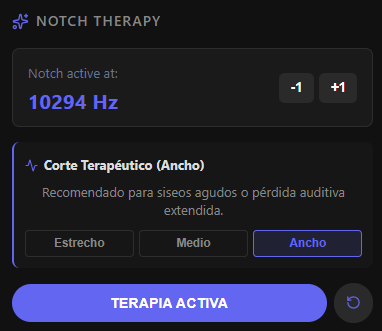
This is the most powerful tool on the platform. Notch Therapy consists of listening to noise or music that has had your exact tinnitus frequency "cut out" (silenced).
- How to use it: Use the calibrator to match the tone you hear in your head. Then, activate the filter.
- Why it works: By listening to a sound spectrum that lacks your tinnitus frequency, the neurons producing the ringing stop being stimulated. With sustained use, this helps "deactivate" hyperactive neural networks, reducing perceived volume.
2. Spatial Mixer and Panning
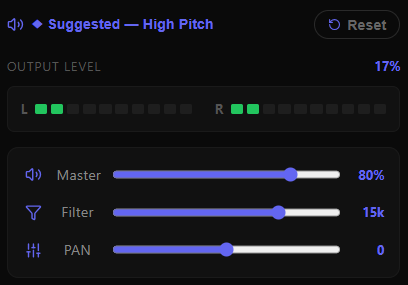
Relief rarely comes from a single sound. The Advanced Mixer allows you to combine textures to create a personalized soundscape.
- Frequency Cutoff Filter: Very useful if you need to remove all frequencies beyond a certain range. This allows you to focus on frequencies that are more pleasant or helpful for masking your tinnitus.
- The Power of Panning (L/R): If your tinnitus is louder in your left ear, you can move the therapeutic sound slightly to that side using the panning controls. This tricks the brain, forcing it to focus on the external sound instead of the internal one.
3. Multichannel Mixer
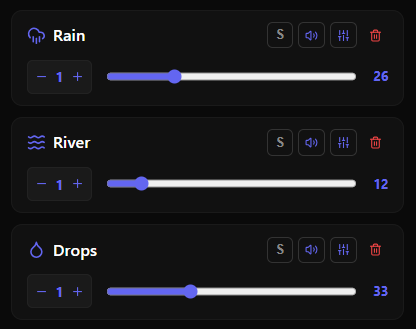
The Multichannel Mixer allows you to independently control each audio channel, adjusting its volume, panning, and frequency filters to create a personalized soundscape.
- Channel Switches: Very useful if you need to listen to or mute a channel separately without destroying or unbalancing the mix.
- Independent Panning (L/R): Place the sound in the auditory space to create a more immersive experience.
- Add Sound Layers: Add sound layers to enrich the mix.
4. Noise and Tone Generator
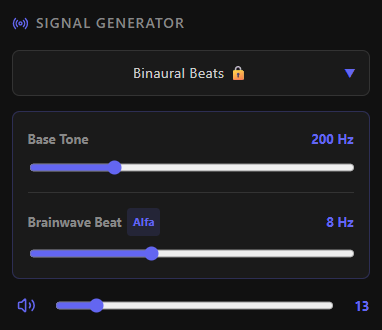
The Noise and Tone Generator allows you to create specific sounds to mask your tinnitus or for personalized auditory therapy.
- Tone Generation: You can create specific tones to mask particular frequencies of your tinnitus. Adjusting the frequency and volume allows you to personalize your auditory therapy according to your needs.
- White vs. Pink Noise: White Noise covers all frequencies equally (ideal for masking high-pitched ringing). Pink Noise has more energy in the lower frequencies, sounding deeper and more relaxing (like a waterfall), ideal for people with hyperacusis (sound sensitivity).
- Custom Noise: You can create noise with specific characteristics, such as brown or blue noise, to better suit your auditory needs and personal preferences.
- Binaural Beats: You can create the illusion of a third tone inside your brain by playing two slightly different tones in each ear. This can aid relaxation and personalized auditory therapy.
5. Your Own Sounds (Mic & Uploads)

Your environment directly impacts your nervous system. The application allows you to incorporate custom audio to create positive emotional associations.
- Clinical Benefit: Combining therapeutic noise (like pink noise with a Notch filter) with a sound that feels emotionally safe to you (like a loved one's voice, your own library of relaxing sounds, or the ambiance of your favorite place) accelerates the relaxation process of the sympathetic nervous system, reducing anxiety associated with the ringing.
6. Sleep Timer with Fade Out

The most difficult time for tinnitus is usually bedtime, when the contrast between the ringing and the silence of the room is greatest.
- How to use it: Set the timer for the amount of time it usually takes you to fall asleep (e.g., 45 minutes).
- Why Fade Out is vital: An abrupt cut in sound would wake your brain by putting it on alert. Our system imperceptibly reduces the volume over the last few minutes. Your brain transitions to silence naturally without triggering neurological alarms.